Episode Two: Bomba the Jungle Boy
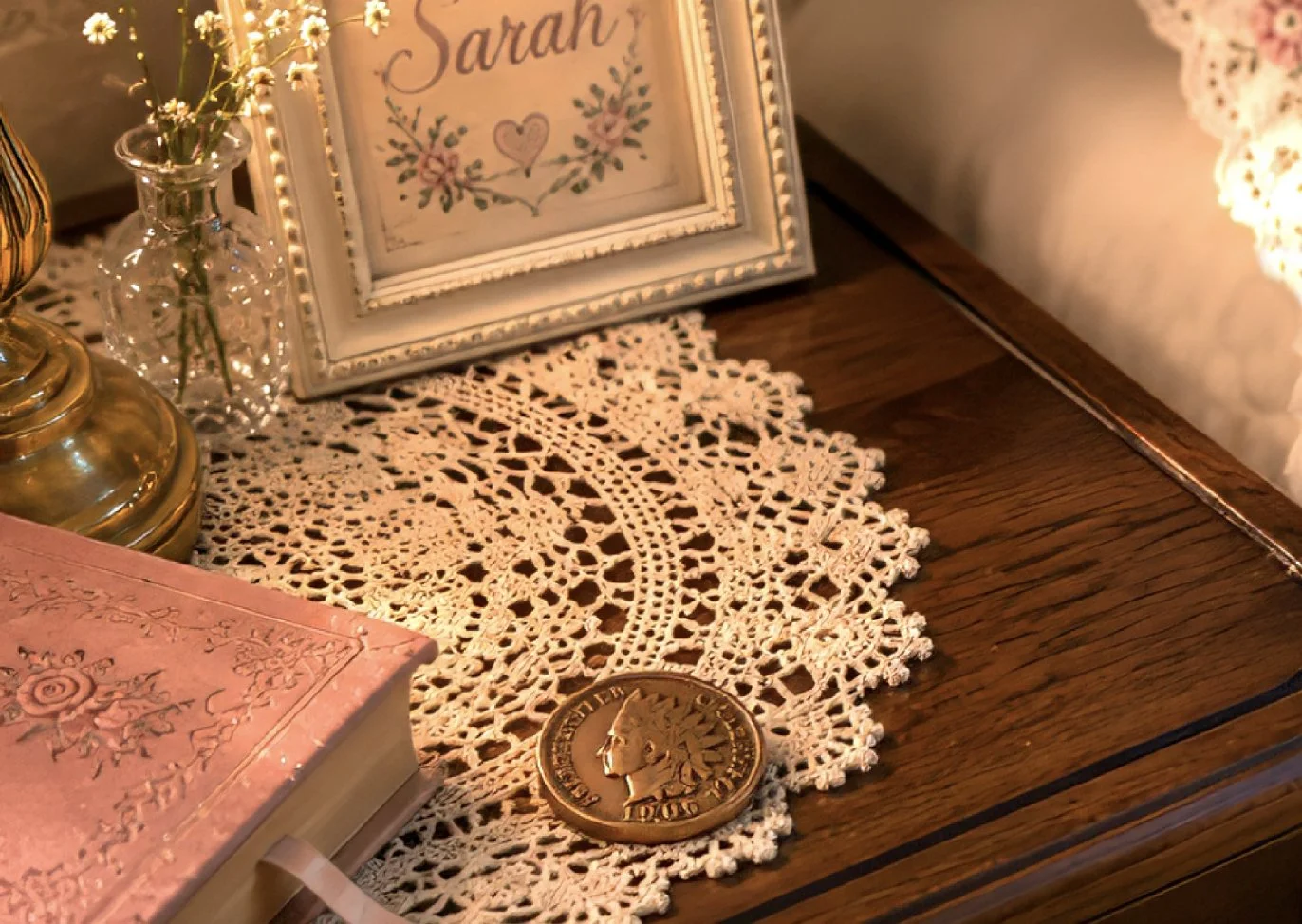
Sarah was awake before her alarm.
She lay still for a moment, staring at the ceiling the way she did on Saturday mornings, letting the day arrive slowly instead of rushing at it. Somewhere down the hall she could already hear the particular sounds of Wayne being cheerful in the kitchen — the soft clank of a pan, the hiss of the burner catching, the small tuneless sound he made when he thought nobody was listening.
She turned her head and looked at the nightstand.
The penny was there.
It was always there on Saturday mornings. She didn't know how. She didn't know if it was Wayne who put it there, or her mom, or something else entirely that she couldn't explain and had stopped trying to. It just showed up, the way the library showed up on the fourth floor of a three-story building and Railroad Bob showed up behind his desk and the Mungie book showed up open to a new page every week. Some things in her life right now didn't have explanations, and she was slowly learning to let that be enough.
She reached over and held the penny in her palm. The Indian head looked up at her with that same patient expression it always had. She closed her fingers around it.
Two hours until nine o'clock.
She could smell bacon now. And toast. And underneath everything, the dark, comfortable smell of coffee that she didn't drink but associated entirely with mornings that felt safe. Her dad had drunk coffee. Two cups, black, standing at the counter reading the paper while she ate cereal. She hadn't thought about that in a while. She thought about it now.
She got up.
Wayne was at the stove when she came into the kitchen, and he turned around with the particular expression he got when he was proud of something he'd made. The pancakes were already on the plate. Blueberries arranged in the shape of a face — two eyes, a lopsided smile — looking up at her with more optimism than a pancake had any right to have.
"Tada," Wayne said, unnecessarily.
Sarah looked at the pancake face. She looked at Wayne. "You know that's ridiculous," she said.
"Absolutely," Wayne agreed, and set the plate down in front of her.
She poured too much maple syrup on the dopey face and ate the whole thing.
The scraped-clean plate was the ultimate affirmation for Wayne. He turned to put the breakfast plates in the dishwasher and whispered to himself. “Baby steps. Empty plates equals a win.”
These weekend mornings were different from weekday mornings. Weekdays had the machinery of the week in them — school, schedules, the organized movement of people who had places to be. Saturdays had this. Wayne's pancake faces. Her mom's quiet coffee at the table. The penny on the nightstand. The two hours that stretched between waking up and nine o'clock feeling both too long and not long enough.
She missed her dad on Saturday mornings more than any other time. She couldn't entirely explain why. Maybe because Saturdays used to be his. Maybe because the version of Saturday she was living now — which was genuinely fine, which was actually pretty good in its own way — was a reminder that it used to be different. Wayne was trying. She could see how hard he was trying. She was grateful for it in a way she couldn't quite say out loud yet.
But Saturdays were also the day she got to see Mungie again. And that helped with everything.
At nine o'clock exactly, the library doors were unlocked.
Sarah pushed through them and looked immediately toward Bob's desk.
It was empty.
A small spike of something moved through her chest — not quite panic, but close enough to notice. The lobby felt different without Bob's particular presence anchoring it. She stood still for a moment, looking around.
Then she heard him. Coming down the side corridor, carrying a tall stack of books against his chest with the practiced ease of someone who had been carrying stacks of books for approximately forever. He was heading toward the west side exit — the monthly book fair, she remembered. Approved state-sanctioned titles only, of course. Bob would never part with anything from upstairs. The books going to the fair were the other kind. The official kind. The flat, approved, nothing-surprising-inside kind. Bob set the books onto the rolling cart.
He spotted her, and his face did the thing it always did when he saw her on a Saturday morning.
"Hi Sarah," he said warmly. "It's so good to see you today."
She crossed the lobby and gave him a brief hug — and in that same motion, quiet as a covert secret handshake, she pressed the Indian Head penny into his palm.
Bob continued to his desk without breaking stride. Dropped the penny into the locomotive bank with a soft clink.
Somewhere above, a latch released.
Music, Sarah thought. That sound is actual music.
"Have fun, Sarah," Bob said, already turning back to his books.
And off she went.
She thought about her question on the stairs. This was the other thing about Saturdays — the question. She'd been turning it over since she woke up, trying to plan it, trying to steer it somewhere useful. It rarely worked that way. The question almost always arrived on its own, generated by the story itself rather than by anything she'd decided in advance. She'd learned to trust that. The spontaneous question was always more real than the planned one. More personal. More hers.
Last week Mungie had told her he didn't have a dad. He'd said it the way you say something you've made peace with — quickly, and then moving on. But she'd carried it with her all week. The wiffleball in the front yard. The mirror. Just with a wiffleball and a mirror.
She wondered what this week would bring.
She pushed open the heavy soundless door and stepped into the room that smelled like real life.
The book was already waiting and waiting to be touched and cracked open, revealing the start of the weekly reveal. Sarah’s hand touched the spine with the silky, gentle apprehension that seemed to come with scooting up next to an old friend when sharing a secret.
Mungie had a system for getting rich. The system collected Coke bottles and returned them for money.
Every house on the block had them. Tucked behind garage doors, stacked in kitchen corners, stashed under sinks. Most people didn't think much about them. Mungie thought about almost nothing else. A Coke bottle was worth a nickel at the market — sometimes a dime if you cashed in the big ones — and Boys Market on Glenoaks and Hubbard didn't ask questions about where you got them. You walked in, went to the back of the store (near the bathroom), and waited for the store clerk to count up your loot. He gave you a slip of paper with the tally, and you got money at the register. That was the whole transaction. Clean and beautiful.
On a good Saturday, Mungie could work ten houses and come out with fifty bottles. Fifty bottles was enough for baseball card packs (with the stiff and stale bubble gum inside), and still have change left for the movies.
But this particular Saturday, Mungie had a different plan.
He'd been watching Bomba the jungle boy on the television in his grandparents' front room for three weeks running, and something about that kid had gotten into him in a way that Sky King, The Lone Ranger, or Superman never quite had. Bomba ran through the African jungle with a spear, not a slingshot or a gun, a real spear that he threw at things and it stuck. Mungie had been thinking about that spear with the focused intensity that he normally reserved for Tommy Davis rookie cards.
He counted his Coke bottle money twice. After three weeks of collecting, he finally had enough.
He went back out.
San Fernando Sporting Goods was his destination, on Maclay Street. He'd ridden his bike past it many times and set his heart on the hunting knives in the glass case near the register. Seven inches of serious business, just sitting there under the light.
He told nobody where he was going. This was not unusual. Nobody asked.
The ride there was five miles, which Mungie calculated as approximately forever, but Bomba didn't complain about distances and neither would he. He rode down Herron to Hubbard, cut across to Maclay, and followed it all the way down into town with the money burning a hole in his pocket and his mind on how to make the spear.
The man behind the counter at San Fernando Sporting Goods wore a short-sleeved shirt and had the general air of someone who had seen everything in life. He looked at Mungie. He looked at the knife case. He looked back at Mungie. “You're in the Boy Scouts, right?”
He sold him the knife.
No other questions. No forms. No “Does your mother know you're here?” Just the knife in a paper bag and Mungie back out on the sidewalk in the afternoon sun feeling like the wealthiest nine-year-old in the San Fernando Valley.
Dean Wilson’s backyard had bamboo. Serious bamboo — thick as a broom handle, growing in a cluster by the back fence that Dean's dad had been meaning to cut down for approximately three years without ever getting around to it. Mungie had noticed this bamboo weeks ago, the way Mungie noticed everything that could theoretically become something else.
He showed up at Dean's back gate with the knife and a roll of electrical tape he'd borrowed from his grandfather's garage, of course, without asking.
Dean looked at the knife. "Where'd you get that?"
"Sporting goods," Mungie said, which was completely true and answered nothing.
They cut the bamboo with a hacksaw, which took longer than expected and resulted in additional skinned knuckles, and then Mungie did the thing he'd been planning in his head all week. He split the thick end of the bamboo shaft, stripped the plastic handle grips off, jammed the blade hilt of the knife in deep, and wrapped the whole joint in electrical tape until it was solid and tight and looked, if you squinted in the right light, exactly like something Bomba would carry through the jungle.
He hefted it. He threw it into the ground by the back fence.
It stuck.
Mungie stared at it for a moment. Then he looked at Dean. .
"Bomba," Mungie said.
They spent the rest of the afternoon in Dean Wilson’s backyard jungle, throwing that spear at every tree, fence post, and patch of dirt that held still long enough. Nobody lost an eye. Nobody lost a finger. The bamboo cracked on the fourteenth throw, and Mungie rewrapped it with more tape and kept going.
When the sun started dropping behind the Wilsons' roof, Mungie pulled the spear out of the dirt one last time and held it over his shoulder the way Bomba held his in the opening credits — chin up, eyes forward, completely unafraid of everything the jungle might send his way. As he did, Dean's big brother, Carl, came home from work and chased the jungle boy out of his backyard.
Fearing someone would tell his Grandpa about the exploits (and the spear), Mungie ran toward Mike's house like a real hunter out for big game. Mike had a big maple tree in his front yard, one that was without leaves at the time, and Mungie, with a mighty heave, chucked the spear high into the tree. The spear bounced off one branch, ricocheted off another, and a couple more, before slamming itself into the ground, a mere 3 inches from Mungie's right foot. More divine intervention? He didn't think about it then, but Orville Caul walked out the front door, and when Mungie pulled the spear out of the ground, the days of Bomba on the streets of Sylmar had come to a close for good.
Sarah closed the book and sat with it for a moment the way she always did now, letting the story settle before she stood up. Outside the window of the third-floor room that shouldn't exist, the city moved in its approved and documented way. In here, a nine-year-old boy had just ridden his bike ten miles, round trip, alone, to build a spear out of a hunting knife and a piece of bamboo, and the whole thing felt less like recklessness and more like a completely reasonable response to being alive.
She thought about that. About what it meant to just do something because it made sense to you and nobody was around to tell you otherwise.
She looked back down at the page and asked her one question.
"Did you ever think that someone might tell you no?"
Sarah turned her head at the sound of a booming laugh coming from a couple of aisles away.
It was only a moment's distraction, but when she looked back at the open book, words were already flowing across the page.
She never got used to watching them appear. Ink seemed to bloom from nothing, letter by letter, as though an invisible hand had decided this was the exact moment the story should continue. She leaned in a bit closer.
"Naah. I never really thought somebody might tell me no. It never even crossed my mind that pretending and imagining could be something you weren't supposed to do. It was 1962, and I was just... different. The other boys had some supervision—not a lot—but summers were pretty loose back then."
The words stopped.
Sarah waited.
Sometimes they did that.
Sometimes Mungie seemed to be thinking.
A few moments passed before new words slowly appeared.
"I didn't understand what my mom and dad breaking up really meant back then. But I noticed things."
The sentence lingered by itself.
Then another.
"The other kids got called home for dinner. They ate with both their parents. They went on vacations. They went to ballgames together."
Nothing.
Sarah rested her hands on the table.
She had begun to recognize these pauses.
Not every silence meant the story was over.
Sometimes they meant Mungie had wandered somewhere he wasn't entirely comfortable visiting.
Finally...
One word.
"Anyway..."
The letters came faster now.
"There was something a whole lot better than my real dad ever gave me."
A beat.
"Want to hear about it?"
Sarah smiled.
The page came alive.
Mike’s dad used to take Mike to a Dodgers game at Chavez Ravine every year on his birthday. He always invited me to go too. It wasn't a birthday party with presents or cake. It was way better."
"When we rang the doorbell, Orville opened the door and handed every one of us a real silver dollar just for showing up. Seven boys piled into his station wagon. No seat belts. Three of us sliding around in the waaay-back every time he hit the brakes or took a corner."
Sarah laughed.
"On the drive to the stadium we'd all guess how many total hits, runs, and errors there would be in the game. Whoever came closest won another silver dollar." The words slowed again.
"That was better than what life would've been like with my real dad."
A long pause.
Then... "Oh... and I won the Hits, Runs, Errors game in 1962."
Another pause.
"That was the most fun... ever."
Sarah closed the book. She sat quietly for another minute. The Dodgers story was wonderful, and the silver dollars made her smile. But somehow they weren't what stayed with her.
"That was better than what life would've been like with my real dad."
She wasn't sure Mungie even realized how much that one sentence had said.
Across the room, someone laughed. The same booming laugh she'd heard a few minutes earlier. Sarah glanced toward the sound. A boy sat cross-legged between the shelves. It took a few moments to collect her stuff, and by the time she got to his aisle, the laughter was gone. His face was buried in a handful of tissues. His shoulders shook as quietly as they had laughed only moments before.
Sarah looked away. Maybe this floor wasn't just where stories were told. Maybe it was where people found the parts of themselves they hadn't known they were carrying. She returned the book to its place and headed toward the stairs.
Railroad Bob looked up as she crossed the lobby.
"Good visit?" He always asked the same question. It never meant the same thing twice.
Sarah smiled.
"Yeah."
"I'm glad I came today."
Bob nodded as though he'd expected nothing less.
"See you next Saturday."
He started pushing the cart toward the west hallway, then looked back over one shoulder.
"Oh... remind me sometime."
Sarah raised an eyebrow.
"I've got a pretty respectable collection of old Coke bottles." He grinned.
Sarah laughed.
"I'll bet you do."