Episode One: Castlefats
The library opens promptly at 9 a.m. daily. On this cloudy and drizzly Saturday morning, twelve-year-old Sarah Beasley walked in the front door, her Indian head penny hidden in the secret compartment of her favorite backpack. Waving at her stepdad, she pulled open the tall, heavy oak doors and stepped into The Library.
"See you in an hour and a half, Squishball. Call me if you need more time." Sarah's new stepdad, Wayne, loves shouting. She cringed as he belted out his message, as if he were introducing drivers at the Daytona 500 from the press booth while the cars were revving their engines in warm-up. Everyone in a six-block radius now knew he was coming back at 10:30. She really liked him, though. He was trying to be the best dad possible, but her real dad was way more subdued in how he communicated with her. She often thought about how things were before the accident that took her dad two years earlier. That said, when things were really tough, it was Wayne who stepped up with the Storytorium Library idea.
Sarah has been waiting an entire week to read another story about Mungie. She can't wait to find out what that sassy, precocious little boy does in today’s episode.
"Happy Saturday morning, Sarah. What can I do for you today?" Sarah doesn't know the librarian’s proper name; she only knows him by sight and has made up a name for him. She calls him Railroad Bob. He doesn't seem to mind at all.
"Hi, Bob. I've been waiting all week, and I found another indian-head penny." She leans in to whisper her secret message, so close that she can even smell his aftershave. It's the one with the little ship on the bottle—a smell she is reminded of because her real father used to smell like that when he leaned in to wake her up on Saturday mornings.
"I remember the rules, Bob. I need to be little-mouse quiet. No one is supposed to know that there's a room with unwashed stories."
Sarah lives in a time where ALL stories are specifically crafted to fit a generic "approved" theme and an approved storyline criteria. This library is not one of the recently built government-controlled and government-designed libraries. This is one of the few that has a history of old-school architecture and, with it, old-school flavor. Everything Bob does officially follows the government guidelines, but unofficially, the old library is home to secret rooms and magic catalogs. As he does every Saturday, from his weathered desk in the lobby, Bob takes the buttery smooth glance around the room. When the seemingly ancient librarian is satisfied no one is watching, Bob casts a little side-eye look at Sarah. "You know the drill, my sweet little monkey. Where's the entry fee?"
She leans into Bob's face as if ready to tell him a secret. She can feel him smile when they both hear the clinking happen as she drops the Indian head penny into the railroad train bank on his desk. Bob reaches under the desk and pushes a concealed button. Somewhere on an upper floor, she hears the familiar click of the release latch for room 9. Her destination is located on the third floor, even though the elevator only travels to the second. Viewed from outside the building, the old-style facade is a reminder of stylish architecture that could actually accommodate a third floor and is one of the few that could be called warm and homey.
Sarah bounds up the stairs two steps at a time, sprinting to get there before someone finds it open. She pushes on the heavy, soundless door and is instantly greeted by the familiar smells of real life hanging in the air, with no intention of leaving. Walking to the second section, she nervously looks to the right and left.
Occasionally, another boy or girl can be found sitting on the floor in an aisle all alone, grinning or smiling, sometimes even weeping as their minds are immersed in the pages of the book they're reading. Pretending that she's casually checking for just anything at all, she has only one thought in mind: the book called Mungie. It's a unique book, in fact, a magical one. It only displays one chapter every week. You can't go back and reread an old story in the Mungie book, looking for clues to the new story. Every week's chapter is about an experience of a boy who has no tight buddy friends, no real parental guidance or supervision, and has no idea he's a constant target of an enemy who wants him dead. In his childlike innocence, he doesn't realize the nefarious intent of the one who creates opportunities for disaster, or just how Mungie manages to survive those circumstances.
Sarah gently grabs the book, caresses the red spine, and quietly steals away to her favorite corner—the one she always sits in so no one can read over her shoulder. She excitedly opens this week's chapter.
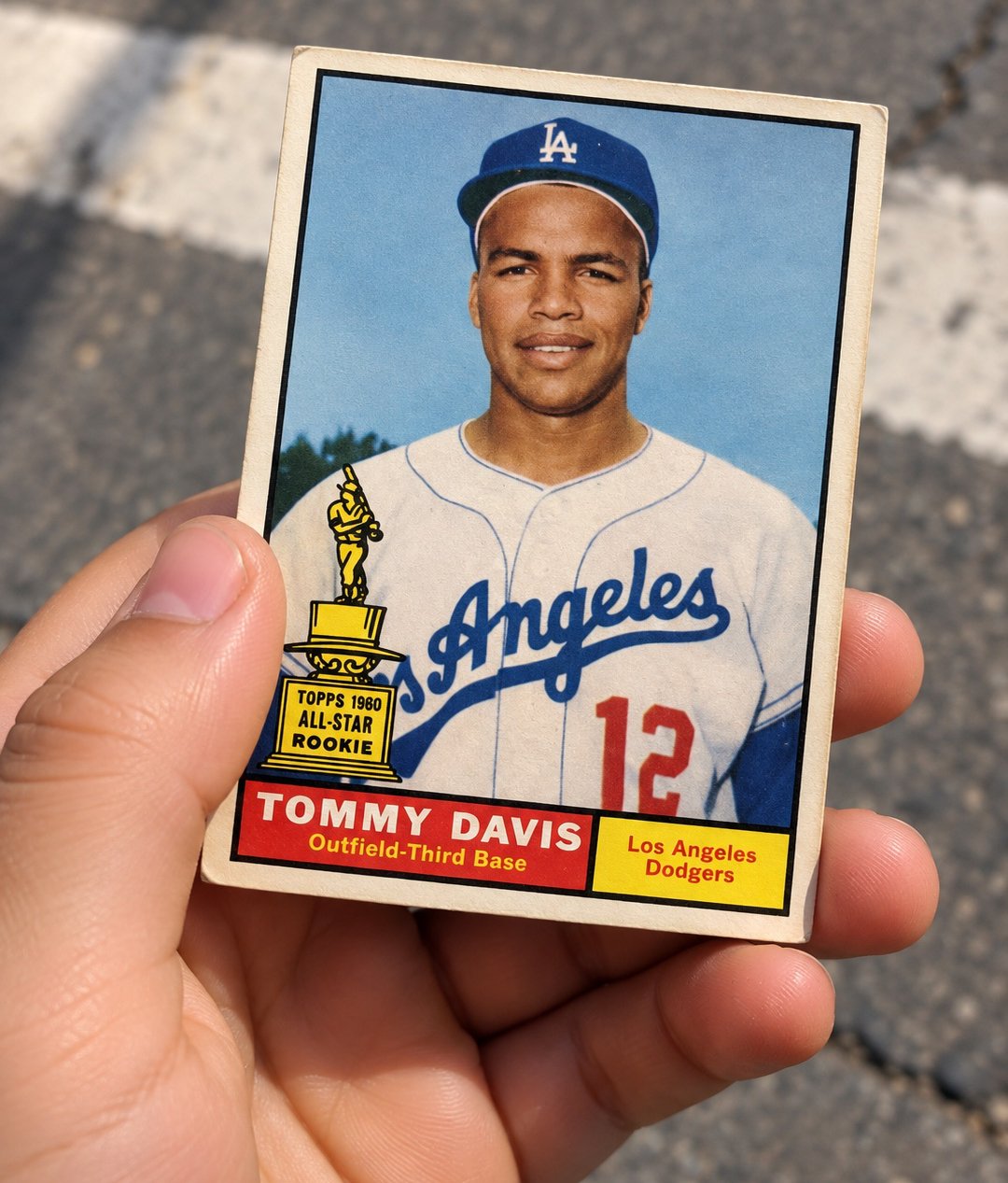
What a great day. Mungie smiles as he leaves Mike's house with the card he's been looking for for so very long. His glassy eyes are mesmerized by the photo on the front side of the card, and he's as distracted as he's ever been in his life. Mungie anxiously walks out of Mike's front door and heads across the lawn to Leonard's house.
"Tommy Davis' rookie card. Now I have Tommy Davis' rookie card. Yes. Leonard is just gonna be sick that I own the entire 1960s Dodgers baseball card set". Mungie only needed the final two Dodgers outfield baseball cards, and yesterday he traded for Willie Davis.
Walking across the street, he carries his shoebox full of baseball cards, his prized possessions. He has cards from his favorite Dodgers players and from almost every other active National League team's players. His favorite is Wally Moon. The home field for the new Dodgers is the Coliseum in LA, and there's a strange layout feature that makes LA fans laugh: a short fence in left field. Really, it's only 200 feet, but it features something crazy—a 30-foot-high net. Wally Moon played in left field and had perfected a trick to play balls hit into left field. When another team's player hit the ball into the net, Wally knew just how to grab the net at the bottom and snap it, sending a ripple up to the top and kicking the ball out. Instead of watching the ball slowly roll all the way down the net, the ripple pops the ball away from the net, allowing him a chance to throw the runner out at second base. He was magnificent at the maneuver.
Mungie doesn't pause at all and just jumps off the curb to cross the street on his way to Leonard's house. Not paying attention to anything else around him, he starts picking through all of his cards, thumbing them in his quiet residential neighborhood, sorting them in order as he walks. It was at that moment that the first part of the disaster happened. He stumbled, and his card box went flying into the air, plopping and fluttering to the ground, unceremoniously and quite messily littering the street with his precious treasures. Oblivious to any possibility of danger, Mungie got on his hands and knees, down in the street, and frantically started picking up his cards, even putting them in order back into his shoebox. That's when the second part of the disaster struck.
Eugene Castleberry (nicknamed Castlefats by the younger kids), a local 19-year-old neighborhood troublemaker who'd been drinking with some other tough kids, came flying around the corner on the east end of the street, and with that, impaired as he was, didn't spot a little kid in the middle of the street collecting his cards. It was too late when Mungie realized the danger and stood up. The center grill of the Chevy struck Mungie like a perfectly planned and timed impact, only this time it wasn't just the cards that went flying through the air.
Incredibly, Mungie landed on his feet, and his neighbor said he shouted at the top of his lungs, "I'm invincible!" But as the words came out of his mouth, Castlefats had jumped out of the car, realizing what terrible trouble he was in, and he started to run away. The car kept moving and hit Mungie again. This time, the blue Chevy wrapped him around the fire hydrant in front of Mike's yard, breaking his pelvis and his right arm. A wobbly and broken Mungie quickly found out that he wasn't quite so invincible after all.
Sarah looks at the last line and carefully considers her weekly question. She loves the opportunity to find out something that's not just an informational product with a storyline. There's just something special about Mungie, something that makes her warm and compassionate towards his adventures. Not all of them are about danger and crazy antics. He just seems so loaded with the flavor of a free spirit, making his own way, like a fearless agent with the heart of a detective. That's it; she asks the book her question.
"Where did you learn how to love those baseball players you are so enamored with? Did your dad teach you?"
She knew that her question was at risk of violating the one-question rule, but she was being sneaky in the formation of the question itself. She had to find out what made Mungie tick. The one-question rule was semi-strict. Should she violate it, it would be another week before she could ask another one, and Railroad Bob would give her the side-eyes as she walked out of the library today.
Sarah watched the page for just a bit longer than usual, and just before she gave up in sad disappointment, the letters began to appear. Like a slow-fingered typist, Mungie answered her question.
"Hi Sarah, sorry it took a bit of time to respond, but I struggle with this answer. Truth is I don't have a dad."
The text paused again.
"I only have a mom and my grandparents at home, oh, and my younger brother."
Another pause.
"My dad isn't around. Really, though, I don't know any different. We live with my Grandma and Grampa, who are old, but cool. I learned about baseball from my Grandma, kinda, and all my friends have dads who love the Dodgers. I do a lot of pretending in front of the mirror that I am Tommy Davis at the plate in a big game. There's always a street game going on after school, with the neighbors, and when they have to go home for dinner, my brother and I play Home Run Derby with a wiffleball in the front yard."
The conversation shifted quickly away from dad stuff, but Sarah could tell it was hard to talk about.
Sarah came down the stairs slower than she'd gone up them. Not sad exactly. Something else. The kind of feeling that doesn't have a clean name yet when you're twelve. She crossed the lobby toward the big oak doors, backpack on one shoulder, the week already folding itself into memory the way it always did the moment she left the room. By the time she reached Bob's desk, she had almost talked herself into just waving and heading outside to wait for Wayne.
Almost.
Railroad Bob didn't look up from whatever he was reading. He had a way of seeming completely absorbed and completely aware at the same time, like a cat near a window.
"Good visit?" he said, to his book more than to her.
"Yeah," Sarah said. "I think so."
Bob turned a page. "Funny thing about boys who grow up without dads." Sarah stopped. "They either spend their whole lives looking for one —” he paused, the way people pause when they're not actually pausing, "— or they figure out pretty early that they were never really missing one." He still hadn't looked up.
Sarah stood there for a second. "Which one was Mungie?"
Bob's mouth did the thing that wasn't quite a smile but was definitely something.
"Come back next Saturday," he said. "Bring a penny."
Sarah pushed open the tall oak doors and stood at the top of the outside steps for just a moment, letting the cool air find her.
Down at the curb, Wayne was already there. Early. He was leaning against the car, scrolling through his phone, and when he spotted her, he straightened up immediately and did that thing with his hand — half-wave, half-hey, there she is — that was so completely Wayne she almost smiled before she'd decided to. She started down the steps.
He tries, she thought. And then, almost immediately, a different thought — quieter, newer: So did Mungie. Just with a wiffleball and a mirror.
Wayne opened the passenger door for her because he always did, as her real dad had always done, and she got in without saying anything.
"Good?" Wayne said, settling behind the wheel.
"Good," she said.
In the back of her mind lingered one thought that would carry her through the coming days…"Come back next Saturday. Bring a penny."