Episode Six: Summers
Sarah looked at her shoes and sighed.
They were perfect, and it bothered her.
No scuffs. Not even a speck of dirt or dust.
It reminded her of how much her life had changed in the past couple of years since her dad died.
Mom and Dad couldn't have been more different. Mom was all about organization and cleanliness. Dad was more mix-it-up and spontaneous. With Dad, planning was loosely structured at best.
Sarah could hardly remember a weekend with him that didn't include some spontaneous side trip somewhere.
Of course, when Mom and Dad went somewhere with her together, things were much more structured at the beginning of the day. Mom had the plan.
But Sarah and Dad had their own little system.
Winks and nods whenever Mom was distracted or wasn't looking.
Summers were different, though.
There was more time to fill. And when Dad was working away from home, Mom usually spent part of every evening planning Sarah's next day.
“Mom, can I just hang out at the park today? I like watching the kids play soccer or just climbing around the playground.”
“I'm not able to watch you at the park today. How about we go to Hobby Lobby and look for some craft stuff? You can work on it at home. Besides, I have you scheduled for the summer library tutoring program this week.”
Ugh.
“OK, Mom.”
Sarah hated summer without school.
Which was why she was very happy it was finally Saturday.
She clutched her Indian Head penny like it was her lifeline to some other planet.
The Library felt like adventure.
Wayne was definitely better at the drop-off, and today was a Wayne day.
Still, “Squishball!” was hard to hear in public, especially in Wayne's booming voice.
Oh well.
As Dad used to tell her all the time:
Pick your battles, kid.
“See you in a bit, Wayne.”
“And with that, I hear that train a-comin'.”
Sarah grinned.
“Hi, Bob! It's Saturday!”
With a stealthy little nudge, the coin passed hands, and the clink of freedom was deposited.
“So I hear,” Bob deadpanned as he pushed the button for upstairs.
Then he stopped.
“By the way, the boy you've noticed a couple of times has had some difficult days lately. Don't be surprised if you hear something from his aisle.”
He gave her a look.
“Remember the rules.”
“I know. Leave others alone. They need Saturdays too.”
Bob nodded.
And with hippy-skippy steps, Sarah made her way upstairs.
A few minutes later, she sat cross-legged on the floor, her nimble fingers finally stroking her book's cover.
The words began to appear.
It always seemed to take forever to get started on weekdays.
A bunch of us kids used to wait at the southeast gate of the Dyer Street School playground pretty much every morning. We'd get there around 7:30 so we could be the first ones through the gate and grab the best balls or carrom boards.
I loved the golf carrom board.
And I was killer-good at it.
The late arrivals—and the losers—got stuck with crummy board games like checkers.
There were two gates that were supposed to open at the same time, but the playground director usually made her way to ours first.
We knew that.
Which was why we were there.
“Hey, Manuel! How're you doing?”
Manuel Encinas and I were friends at school and playground buddies. Same grade, different classrooms.
The yard was our domain during school.
Manuel was the king of Socco, a game that was sort of like dodgeball, only a lot more physical. And I loved it.
In dodgeball, it was pretty much a free-for-all, with kids running around trying not to get eliminated by getting hit with the ball.
Socco was different.
It was a team game, and getting hit didn't eliminate you. Dropping the ball did. If somebody fired the ball at you and you caught it, you got to fire it back at somebody on the other team and try to make them drop it.
It was a strength game.
There were lots of bloody noses in Socco.
Apparently, bloody noses were an acceptable part of the physical education program in those days.
There were also power players.
I was the best in my class, and Manuel was the best in his.
There weren't any titles. No awards. No ribbons.
Just king-of-the-hill playground cred that came from being one of the last guys standing at the end of recess or lunch every day.
The truth was, I thought Manuel was better than me.
I just never said it out loud.
During the school year, everything ran by bells. Recess started, recess ended. Lunch started, lunch ended. With a playground full of kids, we had to get our Socco game going right away.
Summer was different.
We had all day.
We could take our time. Round up some other kids. Make plans for a Socco game. Change our minds and do something else.
Nobody was ringing a bell telling us what came next.
And every week there were bus trips—to parks, museums, even the beach. All you needed was a signed permission slip and a few bucks.
Sometimes local businesses sent sports equipment or sponsored programs at the school playground.
The best one for me was when the NFL and a Ford dealership sponsored a Punt, Pass & Kick competition when I was nine.
I won the competition at our school.
A week later, in the next round, I completely flubbed the Kick part.
I was pretty disappointed.
But I got over it remarkably fast when the next bus to the beach showed up.
At four o'clock, the playground closed and they made us leave.
We never actually wanted to go home.
So we found something else to do.
For three months every summer, that schoolyard practically raised half the neighborhood.
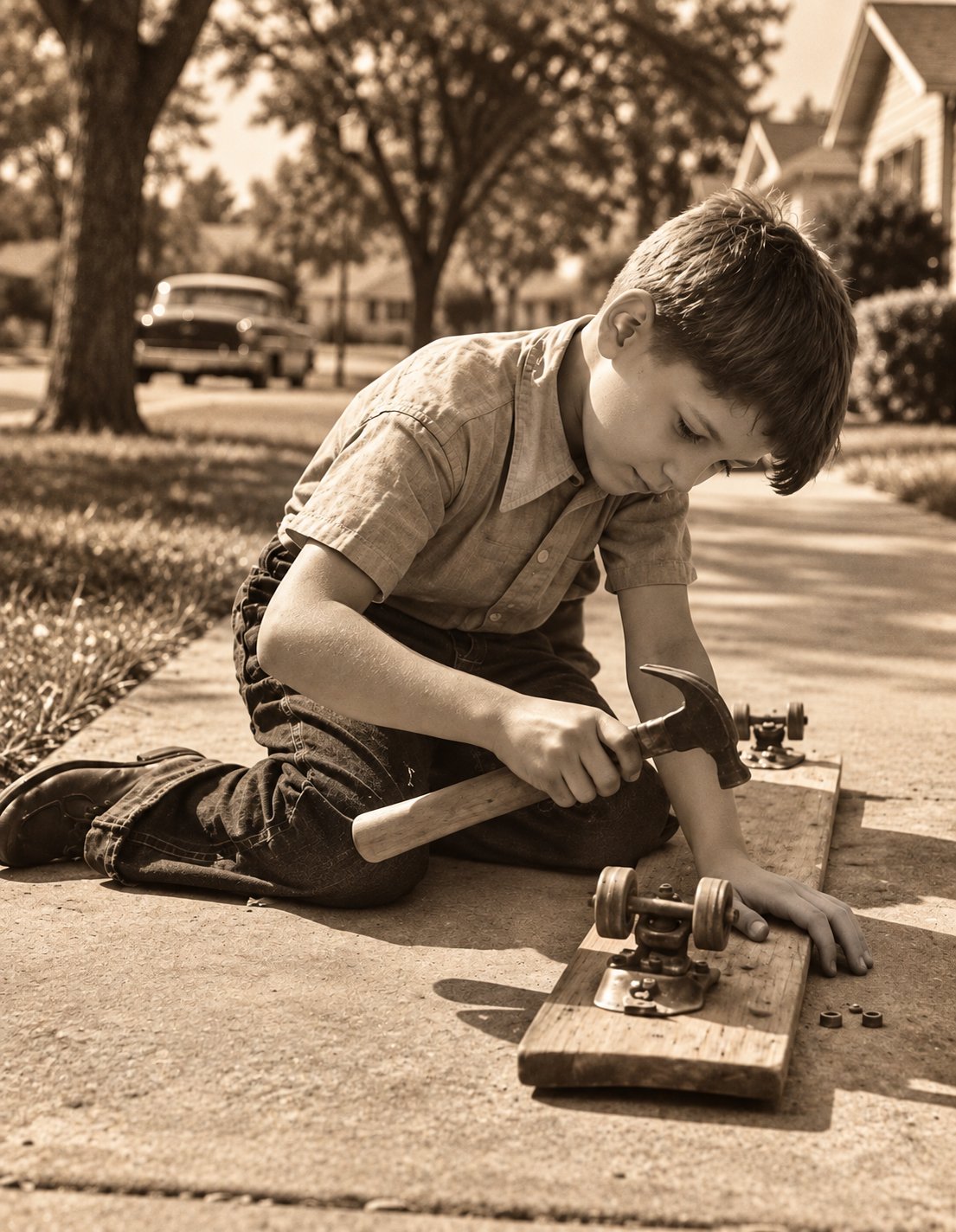
I remember building skateboards out of two-by-fours and my Aunt Eleanor's metal roller skates.
Most of us didn't even have sneakers back then. I had two pairs of hard leather shoes with pretty stiff soles. One pair for playing and one pair for dress.
Our roller skates were metal and adjustable for size. A strap in the back wrapped around your ankle, and clamps in the front grabbed onto the hard sole of your shoe. You tightened them with a skate key.
I thought they were very cool.
But apparently I didn't think they had reached their full potential yet.
My mom wouldn't buy me skates of my own, so I depended on the generosity of my Aunt Eleanor, who was seven years older than me and already in high school.
She thought I was a pest.
Since I lived with my grandparents, though, she was pretty much stuck with me.
One day during summer vacation, I decided I needed a skateboard.
So I grabbed Eleanor's skates—
without asking—
and took them apart.
I nailed them to a two-by-four.
And just like that, I had a skateboard.
I got pretty good at flying around corners on the sidewalks, but those metal wheels didn't work worth a lick on the asphalt streets.
So it was back to Dyer Street School.
Plenty of concrete there.
Plenty of room to become a scraped-up star of the neighborhood.
Sarah thought about the story and considered her question for a bit longer than usual.
“I feel like there always has to be someone watching me. Did you ever have to tell your grandmother or your mom what you were doing or where you were going?”
No.
I never really worried about whether they knew where I was.
Back then, I was pretty much on my own.
But we all were, so it wasn't something we thought very deeply about. You went outside in the morning and eventually you came home.
Some of the kids in my neighborhood were actually locked out of their houses during the day. They didn't go home until the streetlights came on.
I didn't have that problem.
I could come and go pretty freely at Grandma's house. There was always something to eat, and Grandma was always baking cookies or doing something in the kitchen.
She always had time for me.
One of Grandma's favorite stories about me went all the way back to my first day of kindergarten. I heard her tell it to her friends on the phone more than once when they asked how I was doing.
That first day, when the teacher called us in from the playground for nap time, my friend David Rizzi and I had a better idea.
We laid down behind the sandbox and waited until the teacher took everybody inside and closed the blinds.
Then we climbed over the fence and ran home.
“Surprise, Grandma!”
Apparently, Grandma wasn't nearly as excited to see me as I was to see her.
Needless to say, she took me by the hand and walked me straight back to school.
She loved telling that story.
But even though Grandma and I had a real connection, we didn't sit around talking about our feelings or anything like that.
That wasn't how our family worked.
Grandma just seemed to understand me.
And she always went to bat for me.
So even though I spent a lot of time on my own, I don't remember feeling alone.
My family was very traditional. Very blue collar. Very hardworking.
My grandfather worked in a lumberyard, and dependable was probably the best word you could use to describe him. He wasn't particularly warm toward me. He was much closer to my brother.
My brother and Grandpa understood each other.
Grandma and I were different.
She seemed to understand how my mind worked, even when I'm not sure anybody else did. And because of that, she gave me an awful lot of freedom.
Looking back, I'm not sure all that freedom was always the best thing for me.
I did some pretty stupid stuff.
But I also learned how to think on my feet.
Grandma was like that too.
She was the matriarch of our entire family.
The Gallegos family was scattered all over the country, but somehow Grandma knew everything. Somebody was getting married, Grandma knew about it. Somebody had a baby, Grandma knew. Somebody died, Grandma knew.
She was the connection.
Getting back to your question about whether I had to tell somebody where I was going or what I was doing, our neighborhood was pretty self-contained.
There were kids everywhere. We always had somebody to play with, and everybody knew everybody else.
We also grew up knowing that you respected everybody else's parents and grandparents.
There was a safety net around us.
We just didn't know it was there.
Nobody had to explain it. Everybody's parents knew everybody else's parents. If you did something stupid three blocks from home, there was a pretty good chance somebody knew whose kid you were.
We didn't have a phrase like stranger danger.
That wasn't the world we thought we lived in.
We just went outside.
And eventually, we came home.
With that, Sarah closed the Book.
She sat quietly for a minute, smiling to herself.
Mungie climbing a fence and running home from kindergarten was pretty funny.
And she had to admit, she was a little jealous.
Nobody seemed to spend much time figuring out where Mungie was supposed to be.
Sarah's entire life seemed to be made up of people figuring out exactly where she was supposed to be.
She got up and headed across the room toward the upstairs doors.
Then she remembered what Bob had told her about the boy in aisle G.
He'd been quiet the whole time she'd been there.
Sarah slowed down.
She knew she wasn't supposed to, but she couldn't help looking down the aisle.
The boy's Book was on the floor beside him. He was leaning back against the shelves, his head tilted against them.
He was giggling.
Not loud.
Just to himself.
Sarah smiled.
For a second, she thought about walking over.
She didn't.
She knew the rules.
Besides, something about the way he was sitting there told her he didn't need anything from her.
So through the doors she went.
Bob was waiting at the top of the stairs with a sheepish grin on his face.
“Good visit?”
Sarah nodded.
Bob looked past her toward the room.
“Thought about it, didn't you?”
Sarah looked at him.
Then she leaned into Bob for a hug, holding on for just a second longer than she normally did.
“I know better.”
“Good, kiddo. Now get outta here. Wayne's been patiently waiting for you for ten minutes.”
Sarah started down the stairs.
She was almost to the big doors when Bob called after her.
“Sarah!”
She turned around.
Bob was still standing at the top of the stairs.
“He had a good visit too.”
Sarah looked back toward the upstairs room.
Then at Bob.
She smiled.
And pushed through the big doors.