Episode Five: Next Time, Just Swing!
Sarah heard the phone before she was fully awake.
Not the alarm. The other one — the specific two-tone chime Wayne's work phone made, the one that meant something needed him now instead of eventually. She lay still and listened to his voice through the wall, low and clipped, saying words like "how bad" and "I can be there in forty minutes" instead of anything about pancakes.
She looked at the nightstand.
The penny wasn't there yet.
Since she had been going to the Library, that had never happened before. Not once. She sat up.
By the time she got to the kitchen, Wayne was already dressed for something that wasn't Saturday — real shoes, and he was packing things into his briefcase.
"Hey, kiddo." He said it too fast, already reaching for his keys. "Change of plans. My boss lost his luggage on the flight to a big meeting, and I'm the only one who can —" He stopped himself. Started over, gentler. "I have to go in. I'm really sorry."
Sarah's stomach did something small and cold.
"What about the Library?"
"Your mom's gonna take you." Wayne crouched down to her eye level, the way he did when something mattered to him. "I know it's not the same. I know it's usually our thing." He said our thing like he'd earned the right to say it, and lately, she supposed, he had. "I'll be back by the time you're done. I promise."
Sarah nodded because there wasn't anything else to do.
Her mom appeared in the doorway already dressed, coffee in hand, car keys dangling from one finger. "Ready, Sarah-bear?"
Sarah went upstairs first. Found the penny — not on the nightstand where it belonged, but sitting on top of her dresser, like someone had set it down in a hurry on their way out the door. She picked it up. It felt the same. It just wasn't in the right place, and that bothered her more than she wanted it to.
The car ride was quiet in a different way than it was quiet with Wayne.
Wayne always seemed to let silence be comfortable. Her mom filled it — with a question about school, a comment about the weather, a reminder about something happening Tuesday — none of it unkind, all of it slightly beside the point. Sarah answered in the fewest words that counted as polite.
When they pulled up to the curb, her mom didn't just wave from the driver's seat the way Wayne did.
She got out of the car.
"I'll walk you in," she said. "I haven't actually seen this place since we started bringing you."
Sarah's stomach dropped for the second time that morning.
"You don't have to."
"I want to. I've got a few minutes."
There was nothing to say to that. Sarah walked toward the doors with her mother a half-step behind her, and for the first time in five Saturdays, she felt the particular panic of two separate worlds about to touch.
Railroad Bob looked up when the doors opened. He saw the two of them together and blinked — once. That was as close as Bob ever came to looking surprised.
"Well," he said. "Good morning."
"Hi, Bob." Sarah's voice came out too bright, kinda clunky even.
Her mom extended a hand across the desk, warm and a little too enthusiastic, the way she got with anyone she'd decided to like. "I'm Diane — Sarah's mom. I don't think we've officially met. Thank you for looking after her every week."
"My pleasure," Bob said. Perfectly smooth. Perfectly unreadable. "She's one of my best customers."
Diane laughed. "What exactly does she do up here for an hour and a half?"
Sarah's whole body went stiff, and her eyes rolled up and to the right a bit.
"Oh, you know." Bob folded his hands on the desk like a man with all the time in the world. "Reads. Wanders. Kids find their own corners."
It wasn't a lie. Sarah realized, standing there, that it also wasn't the truth, and that Bob had just done something she didn't have a name for yet — protected something without denying it existed.
"Well." Diane glanced at her watch. "I should let you get to it. I've got a nine-fifteen call I'm already going to be late for." She kissed the top of Sarah's head, which Sarah normally would've dodged, but didn't. "Have fun, baby. Text me — well, text Wayne — if you need anything."
And then she was gone, out through the tall oak doors, back into the version of Saturday that didn't include any of this.
Sarah stood very still for a second.
"That was weird," she said finally.
Bob held out his hand for the penny. "Was it?"
"You know it was."
"I know a lot of things." He dropped the penny in the locomotive. "Go on. It's still your hour and a half."
Somewhere above them, the latch released.
Sarah looked at him for one more second—long enough to try to read whatever lived behind his face—and then headed for the stairs, the strange morning already starting to loosen its grip on her the way it always did once she got close to the third floor.
Relieved, she fumbled with the book, and as the middle pages opened, the chaos of the morning and the awkwardness of things being out of place seemed to disappear like shadows retreating on a cloudy day as the sun peeked through.
“What do you have for me today, Mungie?”
I could never sleep on game day, and today was the big game.
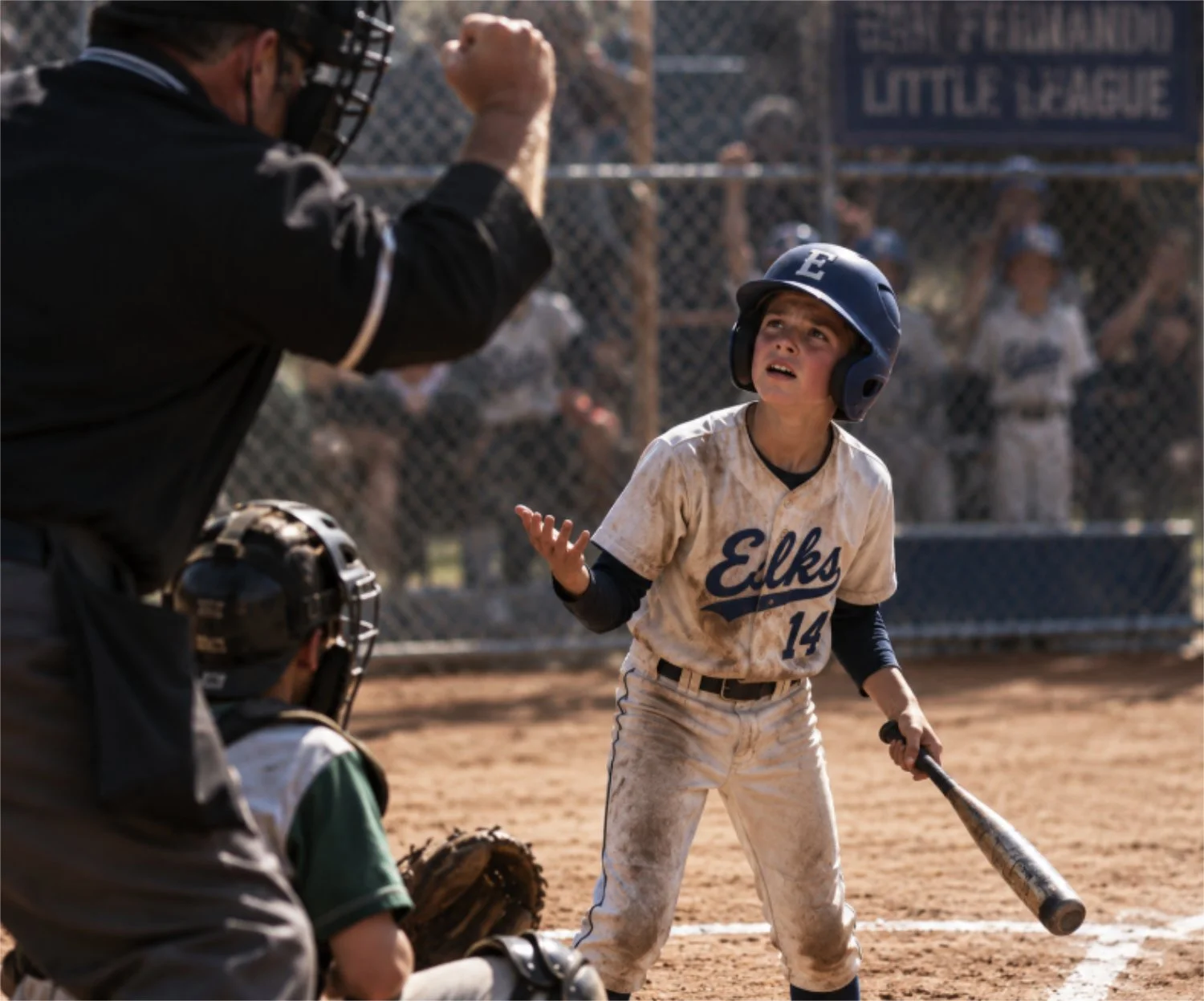
The Elks versus the Eagles.
Tommy Day was on the Eagles.
Mr. Gonzalez had us meet at Wills Field at 8:00 that morning for practice. Game time was 11:30 at the San Fernando Little League field. We were tied with the Eagles. Both teams were 11 and 1.
To me, it felt like a life-and-death experience.
Grandma and Grandpa were going to be there because it was Saturday, and Grandpa was the only driver. Grandma didn't drive. That meant nobody from my family ever came to the weekday games.
But today they would be there.
The walk to Wills Field was short. Herron Street to Herrick Street to Sayre Street. Two blocks and maybe another hundred feet.
I think I floated most of the way.
I had two sets of baseball pants—practice greys and uniform whites. I never wore the whites unless there was a game.
Mr. Gonzalez took that seriously.
"When you look like a real ballplayer, you'll play like a real ballplayer."
That was pretty much the law.
There were twelve guys on the Elks, and none of us ever considered breaking Mr. Gonzalez's rules. In fact, I think all twelve of us wanted the same thing.
We wanted him to be proud of us.
We practiced like we were getting ready for the World Series.
Not one kid on our team rooted for anybody but the Dodgers. On the bench we chewed bubble gum and argued about who was going to get the biggest hit that day. Nobody ever talked about losing.
That wasn't even a possibility.
The only question was who would be the second-best player on the field.
Because everybody already knew who the best one was.
Georgie Gonzalez, coach's son.
Georgie was twelve years old and, as far as I was concerned, a baseball god. He was probably half a foot taller than anybody else on the Elks. He was fast. He threw like Don Drysdale, who won 25 games and the Cy Young Award that year, and he hit like Tommy Davis, who won the National League batting title, hitting .346 with 153 RBIs.
Did I mention that we were absolutely in love with the Dodgers?
I knew everybody's batting average. I knew the pitchers' ERAs. Those baseball cards I collected weren't collectibles.
They were credentials.
A kid needed to know that stuff.
But back to Georgie.
He was the real deal.
It was barely eight in the morning, and all of us took practice seriously because Mr. Gonzalez had convinced us that if we practiced like ballplayers, we'd play like ballplayers.
I stood in the on-deck circle watching Georgie take batting practice and kept thinking about one thing.
In two years, when I'm twelve, could I be as good as him?
I didn't often envy other boys. Baseball gave me too much to be happy about.
But I envied Georgie.
Not just because he was the best baseball player I knew. He had Mr. Gonzalez for a dad.
The final drills were always the best.
Mr. Gonzalez, his brother, and one of the other dads would spread out and watch us while we tested ourselves against grown-ups hitting ground balls and throwing pitches.
During fielding drills, you'd hear somebody yell:
"Butts on the ground!"
The lower you got your butt, the better your chance of making the play.
I was the catcher, so I got to hear all the chatter from whoever was hitting the grounders. And every throw that came back to me mattered. I made sure I caught it cleanly, then casually tossed it back to the coach without hesitation.
Confident and very, very cool. At least that's what I thought I looked like.
With practice over, maybe the funnest part of the day came next. Mr. Gonzales had an old Chevy pickup truck, and 8 or so boys were excited to jump in the back, with all the bats, balls, and those goofy half-ear helmets jammed inside two enormous blue duffle bags. We loved the feel of the truck engine roar and the other guys punching each other, letting off some of that pent-up excitement. We whooped and hollered all the way down Herrick Street to San Fernando Park. I remember cashing in Coke bottles so I could buy baseball cards before a game, just to get some of that hard, crumbly gum slab that came in every pack. It was terrible gum, but by the time we got to the fields, it was finally soft enough to look cool blowing bubbles and popping the rubbery stuff in our mouths.
I was ten. I wasn't going to make the All-Star team that year. It didn't matter that I led the league in doubles, had a pretty good batting average, and had even managed to hit one home run in my first year of organized baseball. Little League rules back then limited the All-Star team to eleven- and twelve-year-olds.
That was okay with me. I was the catcher on the first-place Elks, and I had plenty of time. Next year I'd get my chance. And then the year after that. At ten, you believe there will always be a next year.
Every boy on my block played baseball in the street after school and pretty much all day once summer vacation started.
We didn't have bases, so we made them.
Home plate was a folded-up cardboard box. We'd soak it with water in the morning so that by the time we got home it would be thick and flat and ready for our afternoon baseball rituals.
The fire hydrant was first base. You only had to touch it.
The manhole cover was second.
Third base was the water meter cover between the sidewalk and the curb.
Third was tricky.
You had to come running down the street, jump the curb, and hit that meter cover without killing yourself. There were plenty of falls, slips, and scrapes around third base, but nobody ever really got hurt.
We just played.
Finally, it was game time.
Tommy Day and the Eagles were already on the field taking ground balls and looking every bit like an 11-and-1 team.
Tommy and I both went to Dyer Street School. He was a year ahead of me, and we were friends. In fact, Tommy was part of why I begged my mom to sign me up for Little League tryouts that year.
The Eagles finished their around-the-horn double-play drills, and like confident soon-to-be winners, Tommy and his guys smirked at us as they headed for their dugout.
Then it was our turn. We killed it too.
The game was ON.
I was hitting third that day. Before the game, Mr. Gonzalez put his arm around my neck and reminded me that the third spot in his lineup was reserved for his best hitter. Georgie was hitting fourth. I knew I wasn't the best hitter. Georgie was. But I could almost always make contact, and I hardly ever got nervous during a game.
Mr. Gonzalez and the way he treated me still made me feel special.
Then it happened. The most unexpected thing ever. We were down by one run in the bottom of the seventh inning. Two outs, and I was coming up to hit.
All I needed was a hit. I could be the hero. The exact thing we'd all been chirping about on the bench that morning.
Tommy was pitching.
I worked the count to three balls and two strikes.
And for the first time I could remember, Tommy called time out to mess with his glove. I suddenly realized I'd have to deliver the big hit.
Everything slowed down.
Three balls.
Two strikes.
Two outs.
And then, standing there waiting for Tommy to throw the next pitch, I made the worst decision EVER.
I wasn't going to swing. I'd let Georgie win the game.
Tommy threw the pitch.
Strike three.
Nobody could believe I'd done it.
But the look on Mr. Gonzalez's face stayed with me.
It didn't even seem to matter later that Georgie won the game in extra innings with a home run.
We won.
Georgie was the hero.
Just like I knew he would be.
And somehow none of that made me feel any better. I had chosen to let somebody else have the glory.
At least that's what I thought I'd done.
At the after-game celebration near the snack bar, Mr. Gonzalez called me over. He put his arm around my shoulder and leaned down close enough that nobody else could hear him.
“Georgie already has tons of game-winning hits,” he said. “Next time, just swing.”
That was it. He squeezed my shoulder and went back to the celebration.
Of course, I couldn't have known that life was going to be kinda mean.
There wouldn't be a next year.
That would be my only year of Little League baseball.
Without taking any time to consider her question for the week, Sarah blurted out the first thing that came to mind.
“I know you felt bad about not swinging, but why was Mr. Gonzalez so disappointed in you, since your team still won the game?”
I’ve thought about that for some time after the game. I wanted to just shake it off and have some fun with the guys, but that wasn’t how things worked.
“WE won, but I lost. I knew it then, but I couldn’t help myself. When Tommy called a time-out to mess with his glove, I just started thinking that if I got a walk, all the guys would cheer and the game would be tied. Tommy would be so nervous that Georgie could win the game, easy.
I would be happy.
The guys would be happy.
Coach would be happy.
My grandparents would be happy.
Everyone would be happy.
What I didn’t think of was if Tommy threw a strike.”
Very long pause
“But when Tommy threw a strike, only the Eagles were happy.”
Sarah felt Mungie’s eyes drop and his sense of blame.
She couldn’t fix any of it, and that was the trouble with only getting one question to ask.
Sarah sat there quietly for what seemed like just a minute, but in fact was half an hour, just thinking about what Mungie said: “We won, but I lost.”
She closed the book and headed down to the front of the Library.
“Good visit?”
Bob gave her the side-eye and tipped his head toward the doors.
“Your mom was here fifteen minutes ago.”
Sarah froze.
“Relax. Wayne's coming.”
“What did you tell her?”
Bob looked offended. “Nothing that wasn't true.”
Sarah smiled. “Pesky Library rules?”
“Pesky Library rules.”
“Hey, Squishball, over here!”
Sarah turned to Bob and cringed a bit, then smiled.
“He’s not really so bad…See you next week.”