Boom
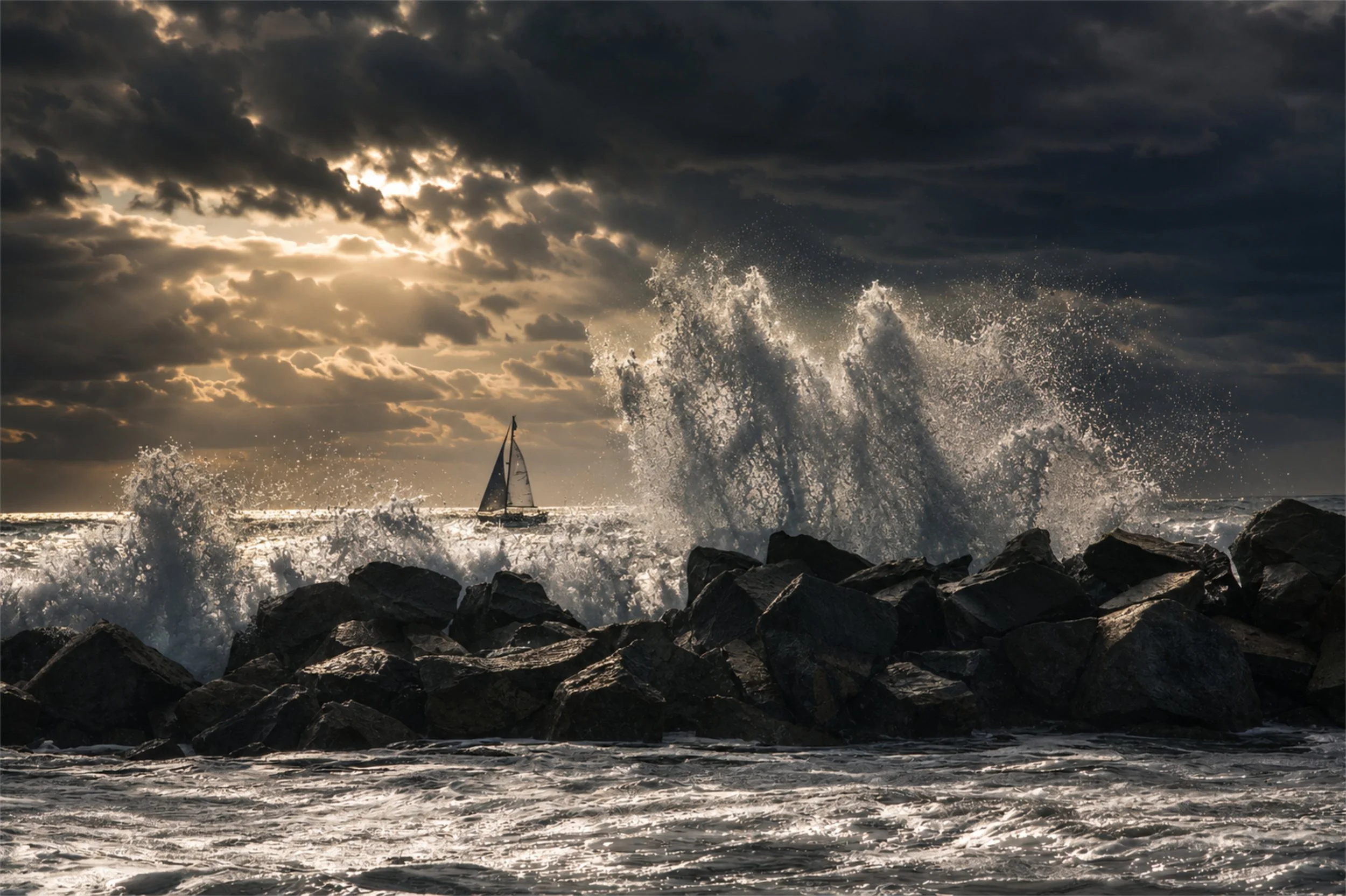
Sixteen years ago, I was standing near the beach watching waves pound the rocks when I saw multiple sailboats moving through the water behind them. In a moment, everything came together, and I became motivated to take advantage of what I hoped would be a great opportunity.
As the boats moved back and forth across the horizon, I was determined to find a way for the rocks to frame the image "perfectly". A wave exploded against the rocks. The sun was behind it all, throwing light through the spray. I wanted to capture the exact pattern of the boom moment, hoping one of the boats would show up in the slot. I knew what I wanted the photograph to look like.
Heavy sigh. I just couldn't make the photograph look that way in post-production.
The backlighting that made the scene so beautiful also made the image terribly grey and flat. The sailboat was a little soft. The water was there, but the individual droplets didn't have the definition I'd hoped for. I worked on the photograph in Photoshop, but every time I tried to pull more out of it, something else seemed to get worse. Eventually I gave up.
The photograph went into a folder with thousands of others and sat there for sixteen years.
Recently, I began experimenting with AI tools while helping a friend restore some old family slides for a memorial service. Watching damaged and faded photographs come back to life made me wonder about some of my own pictures that had never quite worked.
Then I remembered this one. What the heck.
I sharpened the slightly soft sailboat. I brought definition back into the exploding water. I recovered detail in the rocks. And finally, I replaced the flat, grey background with one that gave the scene the drama I'd always hoped to get from the image, but couldn't.
For the first time in sixteen years, I looked at the photograph and thought:
That's what I was trying to photograph.
One AI naysayer commented on a site where I posted the image and made a point I suspect we'll all wrestle with: if artificial intelligence can simply create whatever picture someone asks for, how will we know what's real anymore? And if a machine can create photographs, music, poetry, and stories, what happens to the people who spent their lives learning how to make those things? It's a legitimate question.
I'm an old-school photographer. I also spent decades making my living as a graphic designer. So I have a healthy fear of where some of this technology may lead.
But I have also watched photographic technology change my entire life.
Cameras changed. Film changed. Darkrooms gave way to computers. Photoshop changed what was possible after the shutter was pressed. Digital cameras changed photography again. And now there is another tool. For me, at least, there's an important line. I don't want a computer to go out and take my photographs for me.
I still need to be there.
I want to see the sailboat coming. I don't mind sitting on the beach for 30 minutes waiting. I want to notice the wave beginning to rise. I want to decide where to stand, what lens to use, what shutter speed might freeze the spray, and exactly when to press the button.
Sixteen years ago, I did all of those things.
The technology available to me then simply couldn't finish the photograph the way I had imagined it.
Sixteen years later, it could. It isn't an image that AI created. AI didn't sit on the beach for 30 minutes waiting. I did. It's a photograph that waited sixteen years for the right tool to come along. And somewhere in an old folder on one of my hard drives, I suspect there are a few more waiting their turn.